
Putnam County Court Records After Jail Arrest
The arrest-to-court path in Putnam County usually starts with transport to the Putnam County Jail, booking, and a public jail profile if the person is currently lodged. That profile may show booking fields, holds, and case areas, but it is not the same as the court file. The formal court record starts when charges are filed in Putnam County courts and entered into the Indiana court system.
The Putnam County court page is hosted by the Indiana Judicial Branch and links to MyCase. MyCase is the public case-search path for non-confidential Indiana cases and documents. Use Putnam County jail inmate records for custody and booking details, and use Putnam County jail mugshots for booking-photo questions.
Find Putnam County Court Records After Arrest
MyCase is the main public search path for court records after a jail arrest. It can show case number, parties, court, events, hearings, charge entries, dispositions, financial obligations, warrants, and public documents when they are available online. The official help page says case information comes from courts using Odyssey, that many documents are free online, and that older documents or official records may still require direct contact with the court that keeps the record.
- Open MyCase or the public case-search entry from the Putnam County courts page.
- Search by case number if it is known from jail, court, or bond paperwork.
- Search by defendant name when the case number is not known, then filter to Putnam County or the right court when the interface allows it.
- Open the criminal case and compare the filed charges to the booking or arrest information.
- Contact the clerk or court when a document is not online or when an official certified copy is needed.
The Indiana MyCase help page explains public access, captcha, document limits, and clerk fallback rules.
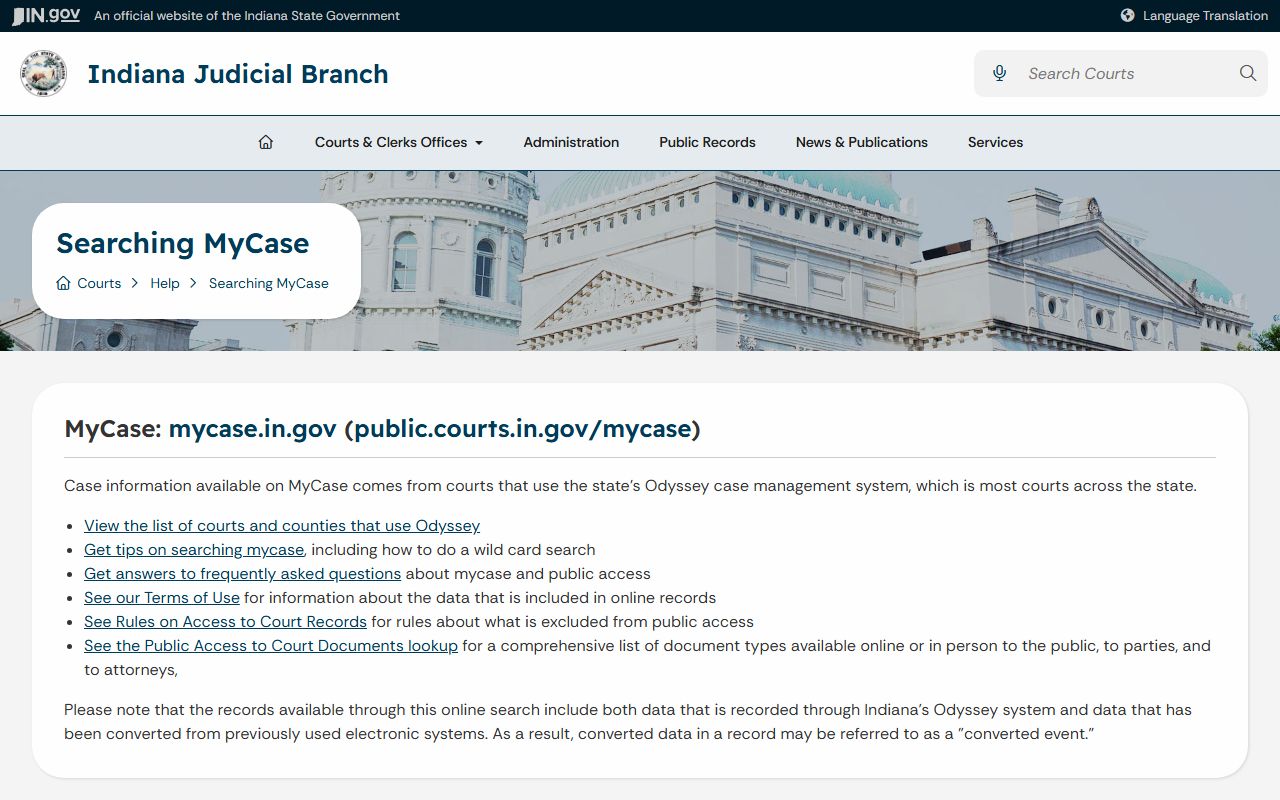
The MyCase help source is important because public web access is useful, but the court or clerk remains the source for official court records.
Putnam County Court Search Fields
MyCase search controls can vary by interface view, but the research captured the main fields and limits. Captcha may appear, especially after repeated searches, to prevent data mining. Search results should be checked against the county, court, party name, and case type before treating a case as the right record.
| Field Label | Type | Required | Notes |
|---|---|---|---|
| Case Number | Text | Optional | Best if known from court or jail paperwork. |
| Name / Party Search | Text | Optional | Use the defendant's name; wildcard help may be available. |
| Court / County Filter | Dropdown or filter | Optional | Choose Putnam County or the relevant court when available. |
| Case Type, Status, Date | Filters | Optional | Use criminal or infraction filters when visible. |
| Captcha | Verification | Conditional | May appear before search results or after repeated searches. |
Charges Filed After Arrest
Booking charges can be preliminary. After a jail arrest, the prosecutor reviews reports and decides what formal charges to file. Those charges may match the jail entry, or they may be amended, reduced, dismissed, or expanded as the court case develops. Indiana uses county prosecuting attorneys, not district attorneys, and Putnam County Prosecutor Austin Malayer's office is the charging office for local criminal cases.
| Document | Common Role | What to Check |
|---|---|---|
| Complaint | Starts or supports a criminal allegation in court. | Facts alleged, offense level, and filing date. |
| Information | Formal prosecutor-filed charge document used in many Indiana cases. | Charge code, count number, and amendments. |
| Indictment | Grand-jury charge document used in more limited cases. | Counts returned by the grand jury and later court events. |
Putnam County Charge Status
Charge status is the court-side status of the formal allegation. It is not the same as custody status. A person can be released from jail while a charge remains pending, or a person can remain jailed because of a hold even when one charge has bond. MyCase and the clerk record are the better places to check the current court status.
| Status | What It Means |
|---|---|
| Pending | The case or charge remains open and has not reached final disposition. |
| Amended or Reduced | The prosecutor or court changed the charge, count, or offense level. |
| Dismissed | The charge was dropped by court action and is not a conviction. |
| Nolle Prosequi | The prosecutor chose not to proceed on that charge or count. |
| Convicted | A guilty plea, finding, verdict, and judgment created a conviction record. |
Bond Orders After Arrest
Putnam County did not publish a dedicated bond page in the official source sweep. The researched path is to check the jail profile for any public hold or case notation, check MyCase for court orders, and call the sheriff before bringing money. The jail visitation rules show that the initial hearing is a key early step because ordinary visitation eligibility begins after that hearing.
| Bond or Hold Type | How It Works |
|---|---|
| Cash Bond | Money paid as ordered by the court, if that type of release is allowed. |
| Surety Bond | A licensed bail agent posts bond under court rules and fee terms. |
| Personal Recognizance | Release on a promise to appear and follow court conditions. |
| No-Bond Hold | Posting money on that matter will not release the person. |
| Detainer or Hold | Another court, agency, probation, parole, DOC, federal, or immigration matter may block release. |
Putnam County Prosecutor Role
The Putnam County Prosecutor is Austin Malayer. The office is listed on the 4th floor of the courthouse in Greencastle, with phone 765-653-2724 and fax 765-653-5526. The prosecutor page lists child support, paternity, pre-trial diversion, traffic tickets, victim assistance, recent cases, Indiana SAVIN, and IDOC offender-search links.
For court records after a jail arrest, the prosecutor's role is charge review and filing. The office may file formal charges that differ from the arrest entry. That is why the jail roster should not be treated as the final charge record. Court filings, hearing dates, bond orders, warrants, and final dispositions belong in the court case, and official documents come from the clerk or court if they are not online.
Warrants and Jail Arrest Records
No official Putnam County Indiana active warrant database was located. Warrant-related custody questions should go to the Putnam County Sheriff's Office at 765-653-3211, and case-specific warrant events should be checked in MyCase or with the clerk/court. Search results from other Putnam counties or third-party sites should not be used as Indiana local authority.
A warrant can lead to a new jail booking, and a warrant or hold can keep someone in custody even when another charge has bond. MyCase may show failure-to-appear events, warrant recalls, or bond orders after a court action. The jail roster may show a hold area, but the court record is the place to verify whether the warrant has been recalled or remains active.
Charges vs Convictions
A court record after arrest must be read by stage. Arrest and booking mean a person was taken into custody or processed. A charge means an allegation has been entered. A conviction requires a plea, finding, verdict, and judgment. Treating a charge as a conviction is a serious error.
| Charge | Conviction | |
|---|---|---|
| Stage | Formal allegation filed in court. | Final judgment after plea, finding, or verdict. |
| May Change | Can be amended, reduced, or dismissed. | Can be appealed or later affected by post-conviction orders. |
| Custody Link | May be tied to jail booking or bond. | May lead to sentence, probation, jail, or prison transfer. |
Sealed and Expunged Arrest Records
Indiana Code 35-38-9-1 addresses expunging arrest records. When an eligible arrest record is expunged or sealed, public access changes as the statute requires, but the record is not destroyed and can remain available to courts and criminal justice agencies for official duties. Court access is also governed by the Indiana Rules on Access to Court Records.
| Sealed | Expunged | |
|---|---|---|
| Public Access | Hidden or restricted from public view under a court order or rule. | Removed from public access under Indiana expungement law when eligible. |
| Criminal Justice Access | May remain available for official duties. | Not destroyed; may remain available to courts and criminal justice agencies. |
| Where to Verify | Clerk, court order, or MyCase if visible. | Clerk, court order, or counsel if the record has been restricted. |
Restricted Court Records After Arrest
Indiana court and public-record rules can limit access to juvenile matters, sealed cases, expunged records, confidential information, and investigatory material. MyCase may not show every document, and official records of court proceedings must be obtained from the court maintaining the record. For jail records, Indiana APRA gives access rights, but agencies may redact protected data or withhold records when an exception applies.
Important: Court and jail lookups are not FCRA consumer reports and should not be used for employment, housing, credit, or insurance screening.